
History
El Batallón de San Patricio
1846 – 1847
The Saint Patrick's Battalion was a unit of several hundred men, mostly Irish Catholic immigrants and other European Catholics, who left the United States Army during the Mexican–American War and fought for Mexico. Mexico remembers them as heroes. The U.S. Army tried most of them for desertion and hanged the largest number of soldiers it has ever executed for a single offense. Both things are true, and the reasons why are the reason this organization carries their name.
Origins
Why They Deserted
By the 1840s, a large share of the U.S. Army's enlisted ranks were recent immigrants, many of them Irish and German Catholics who had fled famine and poverty. Nativist prejudice against Catholics was common in the army's officer corps at the time, and discipline was harsh by any standard — flogging and other corporal punishments for minor infractions were routine. Many of these soldiers found a surprising kinship on the other side of the Rio Grande: Mexico was an overwhelmingly Catholic country, and Mexican commanders knew it. Mexican generals distributed leaflets appealing directly to Irish and Catholic soldiers, promising deserters land, money, and rank if they crossed over.
Not every San Patricio was a U.S. Army deserter. The battalion also included Irish and other European immigrants who were already living in Mexico when the war broke out, Mexican soldiers, and a smaller number of escaped slaves and other Americans. What held the unit together wasn't a single story of desertion, but a shared refusal to fight a war they didn't believe in, against a Catholic country, on the side that had treated them as outsiders.
Formation
The Battalion
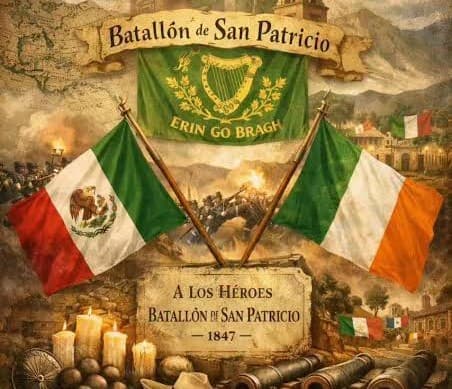
The unit was organized and led by John Riley (Seán Ó Raghallaigh), an Irish immigrant and former British Army drillmaster who had deserted from the U.S. Army at Matamoros in April 1846, before war was formally declared — a technicality that would later matter a great deal. Riley is credited with naming the unit the Batallón de San Patricio and designing its banner: a green flag bearing an image of Saint Patrick, a harp, and shamrocks, with the words “Erin go Bragh” on one side and Mexican symbols and the motto “Libertad por la República Mexicana” on the other — two flags' worth of loyalty on one piece of cloth.
As an artillery unit, the San Patricios fought at Monterrey (September 1846), Buena Vista (February 1847), and Cerro Gordo (April 1847), earning a reputation as some of the most skilled gunners in the Mexican army.
August 20, 1847
Churubusco: The Last Stand
The battalion's defining moment came at the Battle of Churubusco, where some 200 San Patricios held a fortified convent against advancing U.S. forces. Accounts from the battle describe Mexican officers trying three separate times to raise a white flag of surrender — and San Patricios tearing it down each time. They fought until they ran out of ammunition. When the position finally fell, an American officer had to intervene to stop U.S. soldiers from killing the San Patricios they'd just captured, John Riley among them.
Aftermath
Trial and Punishment
General Winfield Scott convened courts-martial for about 72 captured San Patricios. Roughly 50 were sentenced to death. Most were hanged in groups in the weeks that followed; the largest group — around 30 men — was executed near Chapultepec Castle on September 13, 1847, deliberately timed so the condemned would see the U.S. flag raised over the castle as they died. It remains the largest single mass execution in U.S. military history.
John Riley was not among them. Because he had deserted before war was officially declared, military law at the time spared him the death penalty — he was instead flogged and branded with a “D” on his cheek. Several other San Patricios received the same punishment instead of execution, for the same technical reason.
Legacy
Remembered on Both Sides
In the United States, the San Patricios were historically remembered, when they were remembered at all, as traitors. In Mexico, they are honored as heroes who chose conscience over nationality. Mexico commemorates them every year on September 12 at Plaza San Jacinto in the San Ángel district of Mexico City, where a plaque lists the names of the executed. A street nearby is named Calle Mártires Irlandeses — Street of the Irish Martyrs. In Clifden, County Galway — John Riley's hometown — the connection is marked as well, a reminder that this is one story, not two separate ones.
Today
Why We Carry This Name
The San Patricios crossed a line most people were told was fixed — between Irish and Mexican, between one nation and another — because they recognized a shared fight when they saw one. That's the inheritance this organization claims: not the war itself, but the refusal to let an arbitrary line decide who you stand with. We're Irish, Mexican, and Indigenous people and allies, organizing mutual aid, community-oriented self-defense, and cultural education together, because the communities we come from have always been told their fights were separate — and they've never actually been that.
That's not just history. Right now, Irish, Mexican, and Indigenous people alike are being detained and interned without due process — held in immigration detention, processed through courts without guaranteed counsel, in a system that treats survival and presence as crimes. It's the same nativism the original San Patricios deserted an army over, wearing a new uniform. We don't carry this name as a costume; we carry it because the fight it names isn't finished.
Read more about what that looks like today on our mission page, or apply to join.
Further Reading
- Saint Patrick's Battalion — Wikipedia
- “The Mexican-American War Irish Immigrants Who Deserted the U.S. Army to Fight Against America” — Smithsonian Magazine
- Battle of Churubusco — Wikipedia
Historical accounts of exact casualty and execution counts vary by source; figures above reflect the ranges most commonly cited across the sources listed here.